Disclosure: As an Amazon Associate, I earn from qualifying purchases. This post may contain affiliate links, which means I may receive a small commission at no extra cost to you.
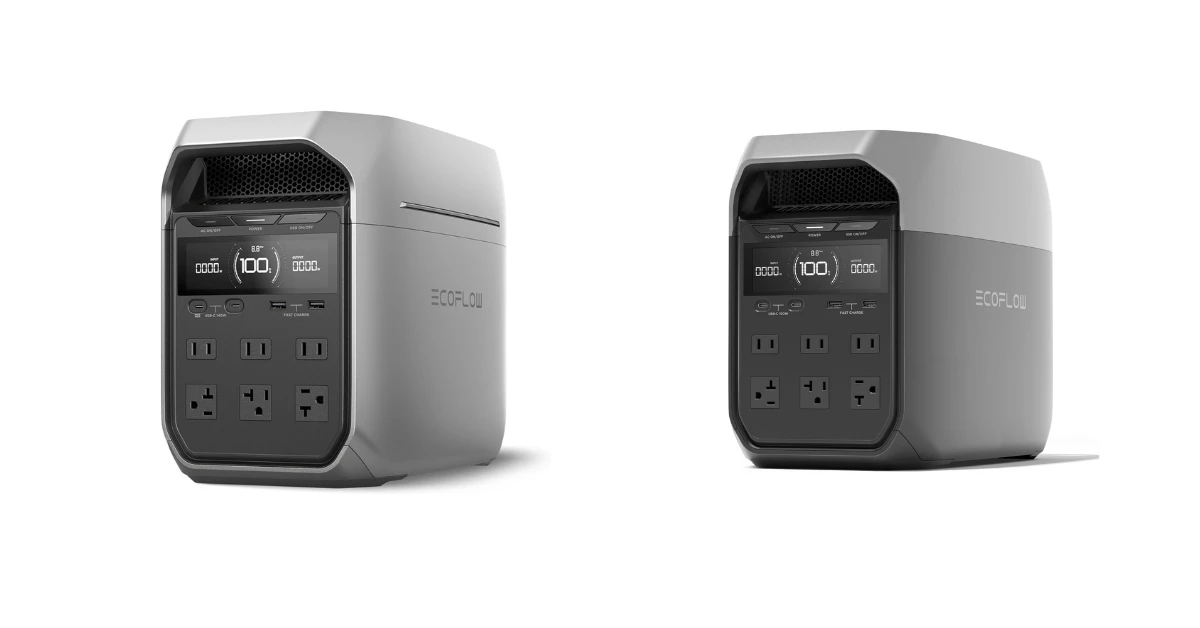
EcoFlow Delta 3 and EcoFlow Delta 2 have some important difference. EcoFlow Delta 3 is the newer and more advanced model with higher solar input, IP65 protection, and longer cycle life. EcoFlow Delta 2 remains a reliable and more budget-friendly option with a lighter design. This comparison will help you quickly understand the differences and decide which one is the better fit for you.
Feature-by-Feature Breakdown
Capacity Expansion:
- EcoFlow Delta 3 has expandable capacity up to 6144Wh for longer off-grid usage and flexible backup power.
- EcoFlow Delta 2 expands up to 3040Wh.
|
Battery Cycle:
- EcoFlow Delta 3 features a 4000+ cycle lifespan to ensure more years of reliable performance before capacity loss.
- EcoFlow Delta 2 delivers around 3000+ cycles to 80% capacity.
|
UPS switch time:
- EcoFlow Delta 3 includes a 10 ms UPS switch time that protects sensitive electronics from noticeable interruptions.
- EcoFlow Delta 2 has a 30 ms UPS switch time.
|
Fast charging:
- EcoFlow Delta 3 supports rapid AC charging that recharges from 0–80% in about 50 minutes for reduced downtime.
- EcoFlow Delta 2 charges from 0–80% in a similar time frame with lower input support.
|
Quieter Processing:
- EcoFlow Delta 3 has improved cooling technology that reduces fan noise to below 30 dB at lighter loads for quieter indoor use.
- EcoFlow Delta 2 produces more audible fan noise at higher output levels.
|
Higher solar input:
- EcoFlow Delta 3 features 1600W solar input that shortens charging time when using multiple or high-watt panels.
- EcoFlow Delta 2 supports up to 500W solar input.
|
Weak-light detection:
- EcoFlow Delta 3 supports weak-light detection that improves solar harvesting efficiency during cloudy or low-sunlight conditions.
- EcoFlow Delta 2 lacks weak-light detection capability.
|
TOU mode:
- EcoFlow Delta 3 has Time of Use mode that helps save on electricity costs by charging at cheaper off-peak hours and discharging during peak demand.
- EcoFlow Delta 2 does not feature TOU mode.
|
IP65 protection:
- EcoFlow Delta 3 includes IP65 water and dust resistance design for outdoor and rugged conditions.
- EcoFlow Delta 2 does not have a rated protection level.
|
Specs at a Glance
| Feature |
EcoFlow Delta 3 |
EcoFlow Delta 2 |
| Battery Capacity |
2048Wh (expandable to 6144Wh) |
1024Wh (expandable to 3040Wh) |
| Cycle Life |
4000+ cycles to 80% |
3000+ cycles to 80% |
| UPS Switch Time |
10 ms |
30 ms |
| AC Output |
2400W (surge 5000W) |
1800W (surge 2700W) |
| Solar Input |
1600W max |
500W max |
| Charging Speed (AC) |
0–80% in ~50 min |
0–80% in ~50 min |
| Protection |
IP65 water and dust resistance |
No IP rating |
| Weak-Light Detection |
Yes |
No |
| TOU Mode (Time of Use) |
Yes |
No |
| Noise Level |
Quieter operation, <30 dB at low load |
Louder under high load |
| Display |
Larger LCD with clearer real-time data |
Smaller LCD |
Who Should Buy What?
Buy the EcoFlow Delta 3 if you:
- Want a power station with the longest lifespan and over 4000 cycles.
- Need higher solar input up to 1600W for faster off-grid charging.
- Plan to use the unit outdoors where IP65 protection is valuable.
- Prefer advanced features like TOU mode and weak-light detection.
- Don’t mind a heavier design for more power and durability.
Check EcoFlow Delta 3 Best Price
Buy the EcoFlow Delta 2 if you:
- Need a lighter and more portable power station for frequent transport.
- Prefer a lower cost while still getting solid capacity.
- Don’t require IP65 protection or advanced modes.
- Use solar panels under 500W and are fine with limited expandability.
- Want a simpler backup solution that is easier to handle indoors.
Check EcoFlow Delta 2 Best Price |
Winner by Category
| Category |
Winner |
| Capacity expandability |
EcoFlow Delta 3 |
| Cycle life |
EcoFlow Delta 3 |
| UPS switch time |
EcoFlow Delta 3 |
| Quieter operation |
EcoFlow Delta 3 |
| Higher solar input |
EcoFlow Delta 3 |
| IP65 protection |
EcoFlow Delta 3 |
| Weak-light detection |
EcoFlow Delta 3 |
| TOU mode |
EcoFlow Delta 3 |
What They Have in Common
- Battery Chemistry: Both the Delta 2 and Delta 3 use long-lasting LiFePO₄ batteries, which deliver thousands of charge cycles and improve reliability over time.
- Fast Charging: Each model supports X-Stream fast charging, allowing them to recharge from empty to 80% in about an hour for quick power readiness.
- Expandable Capacity: Both power stations can connect to extra batteries, giving users the flexibility to increase total capacity for longer runtimes.
- App Control: Each unit pairs with the EcoFlow app, enabling remote monitoring, output control, and firmware updates for smarter energy management.
- Multiple Output Ports: Both models include AC, USB-A, USB-C, and DC outputs, allowing users to power a wide range of devices simultaneously.
FAQ (Quick Answers)
How much capacity can each model expand to?
The Delta 3 can expand up to 6144Wh with additional batteries, making it more suitable for extended off-grid use. The Delta 2 can expand up to 3040Wh, which is sufficient for shorter power needs.
Which model lasts longer in terms of cycle life?
The Delta 3 lasts over 4000 cycles to 80 percent capacity, while the Delta 2 lasts around 3000 cycles to 80 percent, giving the Delta 3 a longer usable lifespan.
How fast do the Delta 3 and Delta 2 switch in UPS mode?
The Delta 3 has a 10 ms switch time that protects sensitive electronics from disruption. The Delta 2 has a slower 30 ms switch time.
Do both models support fast charging?
Yes, both models charge from 0 to 80 percent in about 50 minutes using AC input, although the Delta 3 supports higher maximum charging inputs.
Which product is quieter during use?
The Delta 3 has improved cooling design and runs at under 30 dB on light loads, while the Delta 2 is noisier when operating at higher loads.
What are the solar input limits on these power stations?
The Delta 3 supports up to 1600W solar input for faster charging. The Delta 2 is limited to 500W solar input.
Does either product have official protection against dust and water?
The Delta 3 is IP65 rated which makes it resistant to water splashes and dust. The Delta 2 does not have an IP rating.
What extra smart features does the Delta 3 include?
The Delta 3 includes weak-light detection for better solar efficiency and TOU mode for saving on energy costs, while the Delta 2 lacks these features.
Which model is easier to carry around?
The Delta 2 is easier to carry at around 12 kg, while the Delta 3 weighs around 23 kg and is less portable despite its higher capacity.